


The bamboo that bends is stronger than the oak that resists.
Zen proverb.
The Test You Didn’t Program
Last week I probably lifted more total tonnage than I have in months, but none of it happened inside a gym. Couches don’t come with knurling, plant pots don’t care about your deadlift PR, and bookshelves refuse to stay balanced just because your spreadsheet says it’s a push day.
Modern life has terrible ergonomics, and the physical world doesn’t care about your warm-up routine.
After twenty-seven years of lifting—most of them spent obsessing over kettlebells and barbell mechanics—I finished seven straight days of hauling awkward objects up flight after flight of stairs. I spent hours twisting into terrible positions, carrying asymmetrical loads, and averaging over 15,000 steps per day. My reward at the end of the week wasn’t a PR; it was the fact that I didn’t experience a single hint of back pain.
That was the moment the paradigm shifted for me. The workout wasn’t some isolated ritual preparing me for a hypothetical future; life was actively grading my training.
The Uncomfortable Truth About Functional Strength
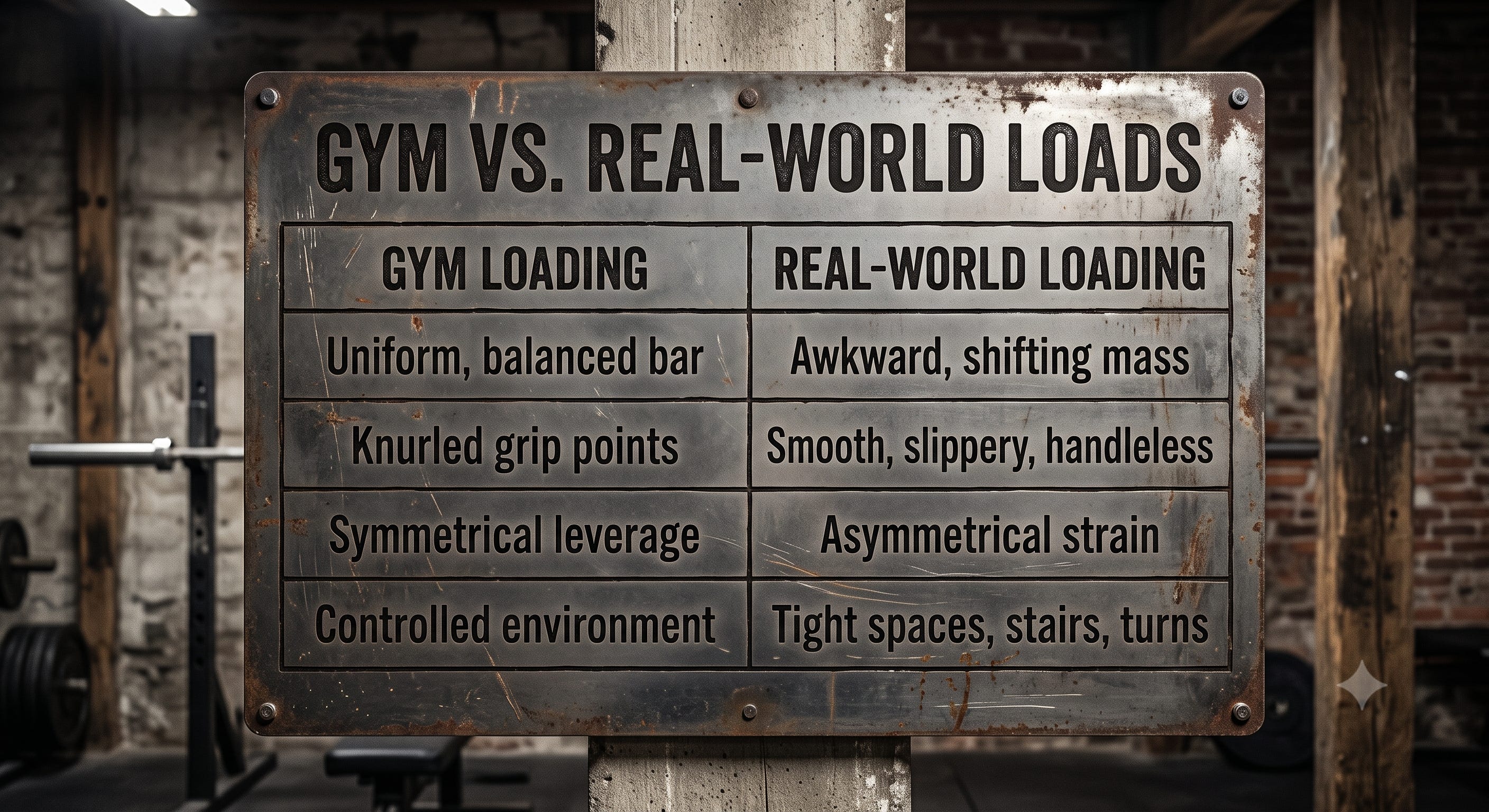
The hardest object I carried all week wasn’t even close to being the heaviest on the moving truck. It was a giant ceramic planter filled with rain-soaked soil: no handles, completely uneven weight distribution, and a center of gravity that shifted every time I took a step. My spine was rounded, my forearms were burning, and I was exactly one bad foot placement away from wearing a fan palm.
Nobody posts videos of that kind of awkward, ugly lift on social media, but maybe they should. Real strength isn’t built on a polished platform under perfect lighting with chalk on your hands. It’s built in the messy, uncoordinated moments when life demands that you pick up something heavy and move it from point A to point B without breaking yourself.
Training for Stonelifting

Looking to buy your own sandbags? Check out my preferred brand Project Kratus (@projectkratus). I have a one time discount code for you! Click PARKER15 at checkout for 15% off.
The best training that I’ve done for “real life” strength is with sandbags for stonelifting. Bar none.
The Illusion of Perfect Conditions
One realization kept coming back to me all week while hauling furniture without a warm-up. Warm-ups are fantastic, and you should absolutely keep doing them—especially if they double as your daily mobility and flexibility work. But when real life demands physical action, it rarely gives you advance notice to foam roll.
The dog gets loose, your kid runs toward the street, or you smell smoke in the middle of the night. Nobody yells, “Take ten minutes to open up your hips!” before a real-world emergency takes place. The physical world is completely immediate, and it expects your body to respond instantly.
If your physique completely falls apart without twenty minutes of activation drills, your training may have become too dependent on perfect conditions. A truly capable body should certainly improve with preparation, but it must also remain remarkably functional without it. That’s why I occasionally train cold—not because it’s optimal for maximum performance, but because it’s honest. Preparation is a luxury, but capability is the actual goal.
At 41, I use strategic warm ups with my clients for mobility inadequacies. However in my own training, I only perform what is needed for that day, or just into a lighter set and get going. In all of the hiking and rucking I’ve ever done in my life, the warm up is simply the first mile.
The Human Economic Engine
On Sunday we hired two movers to finish off the heaviest pieces of furniture. For eight straight hours they never complained, never slowed down, and never once reached for smelling salts or high-caffeine pre-workouts before carrying another massive dresser up the stairs. One of them casually mentioned he’d arrived in America four years ago with $800 in his pocket, spoke no English, and spent his first few weeks sleeping under a bridge.
Now he works simply because work exists, and he even laughed out loud when gas prices came up in conversation. “I don’t worry about it,” he said with a wave of his hand, and that casual sentence stayed with me for days.
He had discovered a truth that most modern gym-goers completely miss: your body is a self-contained economic engine.
If your mind works and your body works, you possess a portable form of practical wealth that no market crash, inflation rate, or bad economy can ever strip away from you. Tests make for good stories, but training makes for a good life.
Later in the afternoon, he asked me a few questions about basic nutrition and staying healthy as you get older. Then he told me this:
“I still drink beer on weekends, and I still smoke a little weed,” he told me with a grin, “but a two years ago I completely stopped eating added sugar. I lost 17lbs. No other changes.”

- Taras from Ukraine
No tracking apps, no macro calculators, and no expensive detox protocols. Real progress rarely comes from buying another complicated supplement; more often, it comes from having the discipline to remove dessert.
My body is definitely an economic engine… I use to be concerned with ME - The Athlete. This shifted in my mid-thirties, now ME is THE COACH. My success is based on the success of my clients.
Now I take my durability seriously: I need my body in order to coach, and performing less-than-completely-safe exercise isn’t worth the chance of injury.
The Only Exercise That Matters
The older I get, the less interested I become in strict exercise selection, and the more obsessed I become with actual capabilities. Can you help a friend move their apartment, load your own truck, hike all day with a loaded pack, or carry your child when they fall asleep? Can you step up and physically help someone in an emergency instead of becoming another person who needs to be rescued?
Those real-world capabilities are vastly better questions than “What’s your incline bench press?” In fact, loaded carries—farmer’s walks, suitcase carries, heavy sandbag holds, and rucking—might be the single closest thing we have to a cheat code for lifelong resilience.
Life itself is essentially one long loaded carry, briefly interrupted by taxes and sleep.
Could Rucking be the perfect practice? Strength ✅ Cardiovascular conditioning ✅ Time outdoors ✅ Efficient recovery ✅.
I ALWAYS lean into the simpler movements for sustainability and compliance.
Escaping the Chair
Modern culture has slowly tricked us into believing that physical comfort is the ultimate measure of personal success. We spend eight hours sitting at a desk, drive home sitting in a car, and then attempt to recover from all that sitting by collapsing onto a couch in front of a screen.
Your physiology is an adaptive system that constantly conforms to the demands you place on it. If you live like a chair, don’t be surprised when your joints stiffen and you slowly start turning into one.
Train for mirror photos if you want, or train for beach season if that’s what gets you through the door. But remember this: nobody has ever called a friend in an emergency because they urgently needed help carrying a dumbbell. Train for life—it’s much heavier, completely unpolished, and it never fits neatly into your six-week training program.
John Parker
StrengthAxis
At some point, everyone gets on the bandwagon of moving well being superior to looking good. And if they don’t . . . they both lose their aesthetics as well as their movement.