


“At some point, training stops being about proving yourself…
and starts becoming about building a life you can actually sustain.”
Most people enter fitness chasing aesthetics.
Bigger lifts.
More muscle.
Better numbers.
But if you stay in the game long enough, the conversation changes.
You start asking different questions:
How do I keep training hard without destroying my joints?
How do I make strength fit into real life?
What happens when your interests evolve?
Can you build a career in fitness without becoming trapped by the industry?
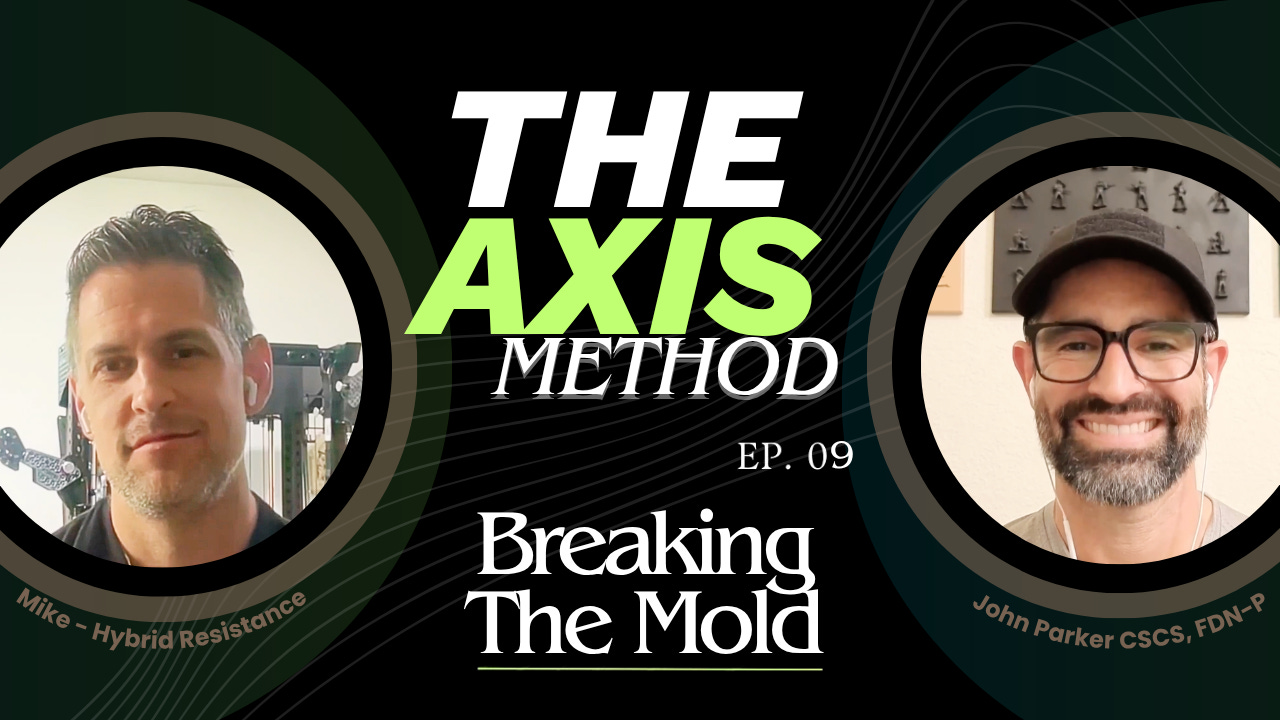
In Episode 9 of The Axis Method, I sat down with Mike from Hybrid Resistance to talk about exactly that:
The evolution of training…
the evolution of identity…
and learning how to build your own path inside strength & conditioning.
Mike has one of the most interesting backgrounds in the fitness space because he’s lived through multiple eras of the industry:
bodybuilding culture
corrective exercise
functional training
home gym evolution
online coaching
content creation
higher education
hybrid training systems
And unlike many people online, Mike didn’t arrive at his philosophy through trends.
He arrived there through decades of experimentation.
Harambe System
This podcast is proudly sponsored by Harambe System - a variable resistance platform that’s become the foundation of my own training over the past two years.
It bridges the gap between bands and weights, giving you smooth, consistent tension through a full range of motion - without the joint stress of traditional loading.
If your goal is to build real strength while staying pain-free and training for the long game, it’s one of the best tools I’ve used.
HarambeSystem.com/JohnParkerBallistic
MED Philosophy.
SECTION 1 - THE EARLY OBSESSION PHASE
Key Points
Bodybuilding magazines and early gym culture
Comic books, superheroes, and physical identity
Discovering lifting as a creative outlet
The “fitness bug”
Why some people naturally fall in love with training
Mike talks about growing up during the early bodybuilding era:
Men’s Health
supplement culture
NO-Xplode
Cell-Tech
bodybuilding forums
commercial gyms
But underneath all of it was something deeper:
Training became a form of expression.
Not obligation.
“Some people view training as a chore.
Others feel drawn to it.”
That distinction matters.
Because long-term success in fitness usually comes from identity — not motivation.
SECTION 2 - THE EDUCATION RABBIT HOLE
Key Points
NASM, ACSM, CHEK Institute
PTontheNet era
Paul Chek influence
Corrective exercise boom
Functional training evolution
This section dives into something many younger coaches never experienced:
The early “functional training” era.
Before fitness became algorithm-driven…
education felt underground.
Mike describes spending hours listening to PTontheNet interviews, studying movement, posture, biomechanics, and corrective exercise long before social media turned fitness into entertainment.
Coaching Perspective
This era shaped an important philosophy:
Movement quality matters.
Not because it looks impressive…
but because your body eventually forces you to respect it.
“You can survive sloppy training in your twenties.
Eventually your body sends the bill.”
As I mention in the podcast… Paul was my inspiration for always training shirtless! Hilarious video.
SECTION 3 - THE FITNESS CAREER MYTH
Key Points
Big box gym burnout
At-home personal training
Building a private client base
The reality of the fitness industry
Teaching, academia, and online coaching
This may be one of the most valuable sections for younger trainers.
Most people think the fitness industry only has two paths:
commercial gym trainer
influencer
But there are dozens of directions inside this field.
Mike talks about:
in-home personal training
education
university teaching
online coaching
content creation
niche communities
hybrid business models
StrengthAxis Perspective
The mistake many trainers make:
Trying to copy someone else’s career path.
“Your niche should come from genuine interest - not forced branding.”
That’s one reason authenticity still matters.
The internet eventually exposes people who don’t actually live the lifestyle they promote.
SECTION 4 — THE HOME GYM EVOLUTION
Key Points
Pandemic-era home gym growth
Why convenience changes consistency
Essential vs overrated equipment
Squat racks, cables, Total Gym, variable resistance
Training freedom
One of the biggest themes of this conversation:
The best setup is the one you’ll actually use.
Not the one that looks coolest online.
Mike discusses:
why certain machines stay
why others get sold
the psychology of equipment
novelty vs staples
creating a training environment that fits your personality
High Value Insight
Home gyms are not just about equipment.
They’re about reducing friction.
The easier training becomes to access…
the more likely consistency becomes.
SECTION 5 — ADVANCED TRAINING CHANGES EVERYTHING
Key Points
Moving away from rigid programming
Auto-regulation
Skill decay in movement patterns
Returning to old lifts
Rotation vs abandonment
This section connects heavily to recent Axis Method episodes.
At the advanced level:
You stop needing constant novelty for progress…
and start needing precision.
Mike explains how he’s cycled through:
bodybuilding
Olympic lifting
calisthenics
kettlebells
martial arts
conditioning
variable resistance
And eventually realized something important:
You don’t have to stay married to one system forever.
StrengthAxis Philosophy
Training should evolve with your life.
“The goal isn’t to prove loyalty to a method.
The goal is to stay capable.”
Sometimes the smartest thing you can do:
Step away from a modality temporarily…
so you can eventually return to it with better perspective and less burnout.
SECTION 6 — WHY ADVANCED LIFTERS OFTEN TRAIN DIFFERENTLY
Key Points
Auto-regulation
Movement quality
Joint preservation
Less ego lifting
Sustainability
One of the strongest themes throughout the episode:
Advanced lifters stop chasing exhaustion.
Instead, they chase repeatability.
The conversation repeatedly returns to:
mind-muscle connection
cleaner reps
smoother movement
lower joint irritation
long-term sustainability
“Training should feel more like practice…
and less like punishment.”
This is where concepts like:
Minimum Effective Dose
variable resistance
auto-regulation
readiness-based loading
become extremely valuable.
Because advanced lifters eventually realize:
Recovery is the bottleneck.
Not motivation.
PRACTICAL TAKEAWAYS
1. Your training should fit your life — not compete with it
2. Consistency matters more than novelty
3. Home gyms work best when friction is reduced
4. Advanced training requires more awareness, not more punishment
5. The best coaches evolve instead of becoming dogmatic
6. Your career in fitness does not need to follow one template
FINAL THOUGHT
One of the reasons I enjoyed this conversation so much is because Mike represents something rare in fitness:
Someone willing to evolve publicly.
No tribalism.
No fake certainty.
No pretending one tool solves everything.
Just years of experimentation, curiosity, and trying to build a system that actually works for real life.
And honestly…
that’s what StrengthAxis has increasingly become about too.
Not chasing extremes.
Building strength that lasts.
Connect With Mike / Hybrid Resistance
YouTube: Hybrid Resistance
Instagram: @hybridresistance
StrengthAxis Links
StrengthAxis Articles & Membership
The Axis Method Podcast
https://strengthaxis.substack.com/podcast
YouTube
https://youtube.com/@strengthaxis
Listen to the full episode of The Axis Method with Mike from Hybrid Resistance below.
John Parker
StrengthAxis


