


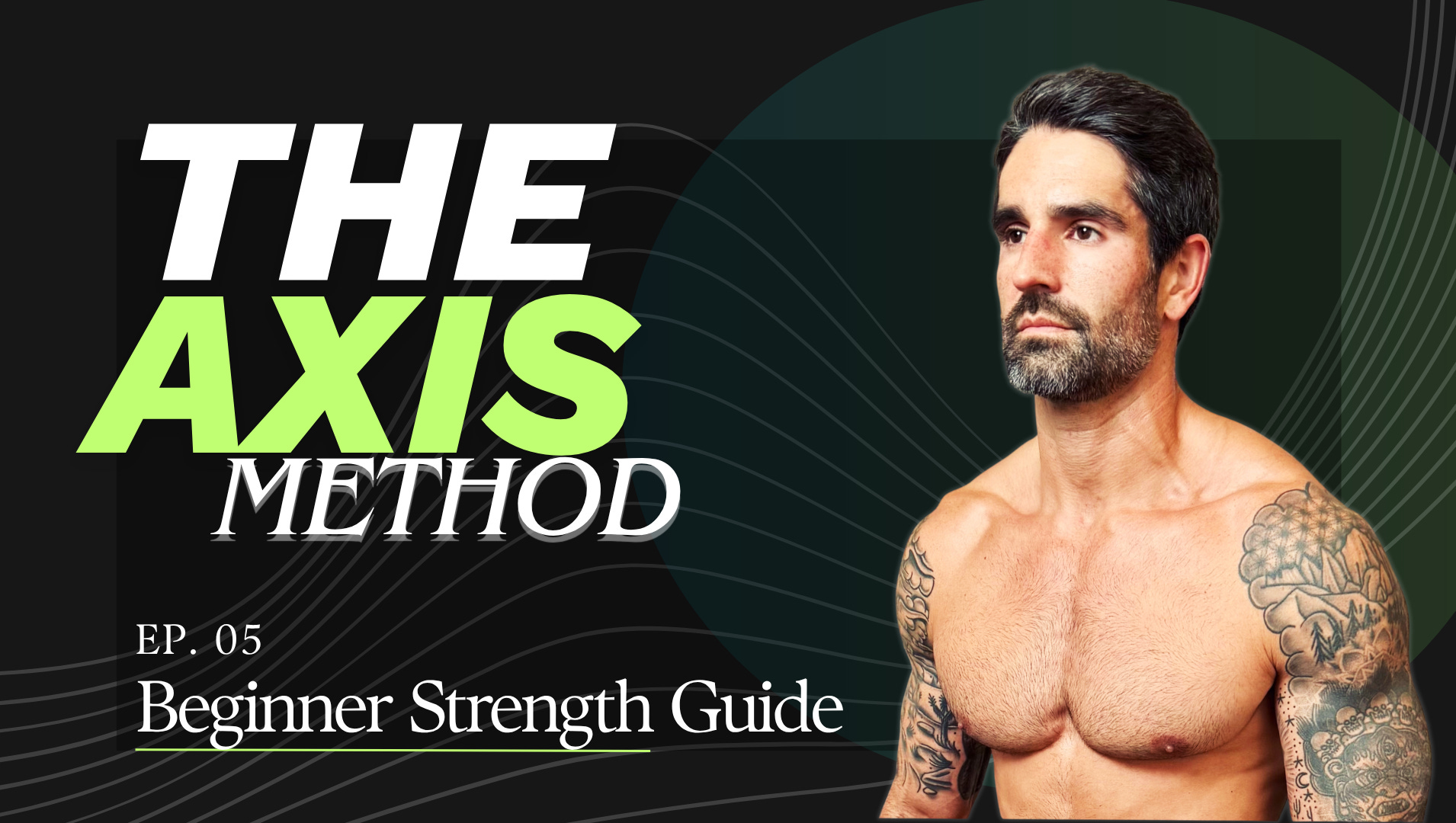
How Beginners Should Actually Start Strength Training
(Step-by-Step Framework)
Most Beginners Don’t Need More Effort - They Need Better Direction
If you’re new to training - or you’ve been spinning your wheels for years - the problem probably isn’t your effort.
It’s your approach.
After 17+ years as a strength coach, I’ve seen the same pattern over and over again:
People do too much, too soon
They skip the fundamentals
They train through pain
They jump from program to program
And they never build real consistency
So today, I’m going to walk you through how I actually take someone from pain and dysfunction → strength → real performance.
This is the framework.
Harambe System
This podcast is proudly sponsored by Harambe System - a variable resistance platform that’s become the foundation of my own training over the past two years.
It bridges the gap between bands and weights, giving you smooth, consistent tension through a full range of motion - without the joint stress of traditional loading.
If your goal is to build real strength while staying pain-free and training for the long game, it’s one of the best tools I’ve used.
HarambeSystem.com/JohnParkerBallistic
The Real Problem With Beginners
Most people don’t fail because they’re lazy.
They fail because they chase intensity before they build function.
They want:
Hard workouts
Sweat
Exhaustion
“Feeling like they did something”
But they skip the foundation that actually produces results.
“If you don’t give a program at least 4–6 weeks, you’ll never know if it works.”
Consistency beats everything.
Phase 1 - Resiliency (Fix Your Body First)
Before we talk about strength…
We fix the machine.
This is where most people need to spend their first 4–6 weeks.
Focus Areas:
Joint mobility (shoulders, hips, ankles)
Muscle length & balance
Stability and control
Pain reduction
What This Looks Like:
Hanging from a bar
PVC shoulder work
Indian clubs
Knees-over-toes progressions
Basic core work (dead bugs, bracing)
You’re not chasing fatigue here.
You’re restoring function.
“Pain-free movement is non-negotiable.”
If something hurts sharply → stop.
If it’s discomfort → assess and adjust.
Phase 2 - Strength Foundation
Now we build.
But we don’t jump straight into heavy lifting.
We earn it.
The Goal:
Gradual load progression
Clean technique
Submaximal training
Consistency over intensity
My Approach:
3–5 core exercises
Full-body structure
Add reps → then load → then complexity
Example:
Week 1: 8 reps
Week 2: 9 reps
Week 3: 10 reps
Week 4: 11 reps
Week 5: De-load to 8 reps, add load
Simple. Repeatable. Effective.
“Strength is built on positions you can own.”
If your positions suck, your strength won’t last.
Strength & Mobility Resources
For those using barbells, Jim Wendler’s 5/3/1 is a great long-term progression model.
- 5/3/1 By Jim Wendler
Here is the StrengthAxis Program Design where I applied 5/3/1 to 7/5/3 using kettlebells. I call this High Tension Grinds.
- 7/5/3 High Tension Grinds
For those needing shoulder mobility, check out these three articles.
- Training Overhead Mobility
- Indian Clubs
- Bombproof Shoulders
This is the General Mobility (full body) that I follow and give my in-person clients.
- The Long Stretch
Want the Performance Tracks? ↓↓↓
Follow these links to April, 2026’s performance tracks (paid subscribers only).
Dumbbell Performance Track
MED Kettlebell Performance Track
Advanced Maximal Kettlebell Performance Track
Variable Resistance Performance Track
The Biggest Mistake: Program Hopping
This one kills progress.
People run:
3 workouts from Instagram
2 from YouTube
1 from a friend
And wonder why nothing works.
“If everything changes, nothing works.”
Pick a program.
Run it for 4–8 weeks.
Track progress.
Then adjust.
Phase 3 - Conditioning & Performance
Once your foundation is solid, now we layer in conditioning.
But not randomly.
Start With:
Daily walking (7–10k steps)
Basic activity consistency
Then progress to:
Kettlebell ballistics (anti-glycolytic)
Light circuits
Sports / hobbies
I’m not a fan of crushing yourself with HIIT.
I’d rather see:
Better recovery
Better movement
Better consistency
“Your hobbies are your best conditioning.”
Hike. Bike. Surf. Play.
That’s real fitness.
Simplicity Always Wins
This is where most people overcomplicate things.
You don’t need:
20 exercises
Fancy equipment
Constant variation
You need:
Structure
Repetition
Intent
“The magic is in the repetition.”
How to Measure Progress (Without Overthinking It)
Track these:
Pain ↓
Range of motion ↑
Control ↑
Strength ↑
That’s it.
Not everything needs to be complicated metrics.
Training Is the Gateway Habit
Here’s the part most people miss.
Training isn’t just about your body.
It’s about your life.
“Training builds the discipline that carries into everything else.”
When you:
Show up consistently
Track your progress
Execute with intent
That spills into:
Nutrition
Sleep
Work
Relationships
Training becomes the glue.
How Much Training Is Enough?
Minimum: 2 days/week (full body)
Ideal: 3–4 days/week
Add: walking + hobbies
That’s it.
You don’t need more.
You need better.
Final Thoughts - Start Simple
If you’re starting (or restarting), do this:
Fix pain first
Build consistency
Progress slowly
Stay in one program
Get 1% better each session
“Most beginners don’t need more effort. They need better direction.”
If You Want Structure
Diana and I released the Dumbbell Performance Track for those training at home and do not own kettlebell or additional equipment. And remember, dumbbells are more than enough for the motivated beginner - they’re incredibly inexpensive, especially if purchased used, and may be the perfect tool for absolute beginners.
One pair of dumbbells
Simple progression
Built for real-world consistency
👉 You can find it inside StrengthAxis (BASE & Elite members)
Listen to the Full Episode
If you want the full breakdown, including coaching examples and deeper explanations:
John Parker
StrengthAxis


