


The kettlebell ballistic landscape is masterfully minimalist. Movements like the swing, snatch, and clean forge an incredibly dense posterior chain, an iron grip, and a highly resilient cardiovascular system. For raw power development under the law of the Minimum Effective Dose (MED), it is practically unmatched.
However, an exclusive reliance on these movements leaves a critical gap in a mover’s architecture: rotational vector management.
If you've never trained with a club before: the movements below — Mills, Swipes, Clockwork Squats, Flag Presses — are going to feel nothing like a kettlebell at first, even at a light load. The offset weight and longer lever mean the club wants to keep moving once it starts, and your job is learning to guide that momentum instead of fighting it. Start noticeably lighter than you'd expect based on your kettlebell numbers, and don't add load until the pattern feels controlled, not just survivable.
If you look at modern hardstyle curriculum, it is built to produce an elite capacity for linear, explosive hip extension. But human movement doesn’t happen entirely in a single, straight line. To stay durable, we have to step outside the sagittal groove.
We become masters of creating and absorbing force strictly forward and backward, but when forced to cut, pivot, rotate, or distribute load through complex fascial lines, the lack of multi-planar exposure becomes a glaring vulnerability.
CMC: Swing + 2H Mill - 40:00 MED.
The Missing Vector in Minimalist Training
In an ideal curriculum, heavy club work serves as the natural bridge. Heavy clubbells force the body to step out of symmetric stance mechanics and into dynamic, rotational, and asymmetrical force management.
Most advanced coaches understand how critical clubs can be to restore organic joint articulation—particularly in the shoulder girdle and thoracic spine—while simultaneously training the fascial lines under tension rather than simply isolating muscle tissue.
A complete, high-yield curriculum doesn’t require dozens of complicated patterns. To fit the hardstyle philosophy of high-transfer minimalism, a tight selection of four core movements would suffice to build complete systemic durability.
It is important to note that while certain heavy club patterns can be executed inside the sagittal plane, the baseline movements selected for Cross-Modality Conditioning (CMC) are intentionally driven by frontal and transverse plane dominance to directly challenge and restore multi-planar capacity.
Mills: Unmatched for overhead thoracic rotation, shoulder tracking, and contralateral hip loading.
Swipes: Excellent for dynamic shoulder extension, overhead positioning, and fluid transitions through the sagittal to frontal planes.
Clockwork Squats: Transitions a standard lower-body pattern into a multi-directional structural test.
Flag Presses: Forging anti-rotational core stability and absolute control over forward transverse vectors.
Because this missing element isn’t codified into standard protocols, I have made it a personal mandate to program outside the dominant hip-extension framework for conditioning.
The goal isn’t to abandon the kettlebell’s ballistic output, but to deliberately layer in heavy, multi-dimensional rotation.
Clubbell Mill
(one arm)
(two arm)
Clubbell Swipe
(sagittal)
(trontal/transverse options)
Clubbell Clockwork Squat
(frontal/transverse)
Clubbell Flag Press
(sagittal)
(frontal/transverse option)
The Cross-Modality Matrix: A Plug-and-Play System
The sessions detailed below illustrate exactly how to program the cross-modality protocol. This is not a rigid routine; it is a fluid, plug-and-play framework.
The specific movements you select for any given session should be dictated entirely by your immediate structural needs and what movement patterns need to be trained or spared on that specific day.
If your upper body is completely fried from heavy pressing, you pivot away from high-demand overhead work and slide in side swings or clockwork squats to keep the system moving.
If your primary objective for the day is restoring deep shoulder and thoracic mobility, you pare down the complexity and focus on one-arm kettlebell swings paired with a lighter clubbell pattern. If you want a comprehensive, full-body mobility and structural audit, you stack a two-handed mill with a forward flag press and a clockwork squat.
Note on Load Selection: The weights listed in the templates below represent my personal “everyday loads”. Scale these weights to fit your individual baseline, ensuring you can maintain absolute technical integrity under systemic fatigue.
Option 1: The Linear-to-Rotational Density Protocol
Focus: Maximum power contrast. Forcing the nervous system to shift rapidly between absolute linear stiffness and rhythmic, multi-planar elasticity.
Format: OTM (On the Minute) for 40 Minutes, alternating movements sequentially.
Minute 1: 7 Two-Handed Kettlebell Swings @ 40 kg
Minute 2: 7 Two-Handed Clubbell Mills (Right) @ 15 kg
Minute 3: 7 Two-Handed Kettlebell Swings @ 40 kg
Minute 4: 7 Two-Handed Clubbell Mills (Left)
Total Session Volume: 140 Kettlebell Swings (40 kg) & 140 Clubbell Mills (15 kg)
Option 2: The Asymmetric Lower-Body Strategy
Focus: Upper-body sparing. Ideal when the shoulder girdle needs a break from overhead tracking, shifting the multi-planar challenge down to the hips and lower kinetic chain.
Format: OTM (On the Minute) for 40 Minutes, alternating movements sequentially.
Minute 1: 7 One-Arm Kettlebell Swings (Right) @ 40 kg
Minute 2: 7 Clubbell Clockwork Squats @ 15 kg
Minute 3: 7 One-Arm Kettlebell Swings (Left) @ 40 kg
Minute 4: 7 Clubbell Clockwork Squats @ 15 kg
Total Session Volume: 140 One-Arm Swings (40 kg) & 140 Clockwork Squats (15 kg)
Option 3: The Complex Mobility & Hinge Tracker
Focus: Maximum structural integration. Combining an elite ballistic pull with a high-demand rotational and lower-body club complex.
Format: OTM (On the Minute) for 40 Minutes, alternating movements sequentially.
Minute 1: 7 Kettlebell Snatches (Right) @ 24 kg
Minute 2: 7 Clubbell Complex Reps: Mill + Clockwork Squat (Right) @ 15 kg
Minute 3: 7 Kettlebell Snatches (Left) @ 24 kg
Minute 4: 7 Clubbell Complex Reps: Mill + Clockwork Squat (Left) @ 15 kg
Total Session Volume: 140 Snatches (24 kg) & 140 Clubbell Complex Reps (15 kg)
Kettlebell Ballistic Options (AXE Format)
For raw ballistic efficiency and systematic simplicity, Pavel Tsatsouline’s Kettlebell AXE protocol remains a foundational benchmark for minimal effective dose training.
The Cross-Modality Conditioning framework directly borrows its structural DNA from that format.
However, through continuous monitoring of my own biometric data—tracking recovery metrics and heart rate performance via my Garmin watch and Garmin HRM strap—I have optimized this specific plug-and-play system to settle on 7 total ballistic reps per minute, rather than the standard 4-to-6 rep range recommended in the traditional AXE protocol.
This subtle volume adjustment maximizes systemic power output without pushing the nervous system past the point of efficient recovery.
Depending on your daily structural audit and training objective, you can seamlessly slot any of the following foundational ballistic options into the kettlebell minutes:
Two Arm Swing
One Arm Swing
Snatch
Overcoming Asymmetry: A Personal Framework
This specific layout highlights how cross-modality training functions as an active diagnostic and self-corrective tool. My background in track and field left me with a highly pronounced movement bias: I could rotate, load, and transfer energy seamlessly off my left side, but turning to my right side always felt restricted, rigid, and blocked.
Standard symmetric double-kettlebell training or straight linear swings can easily hide these discrepancies; the stronger side simply compensates to drive the load forward. By interjecting the 15 kg two-handed mill immediately after a heavy 40 kg ballistic hinge, the body is forced out of compensation mode.
The alternating structure requires the nervous system to rapidly shift gears between absolute linear stiffness and rhythmic, multi-planar elasticity. Over time, practicing this deliberate alternation has fundamentally re-educated my right-side rotation.
It acts as an applied mobility drill for the entire kinetic chain—restoring structural fluidity across the ankles, knees, hips, and thoracic spine.
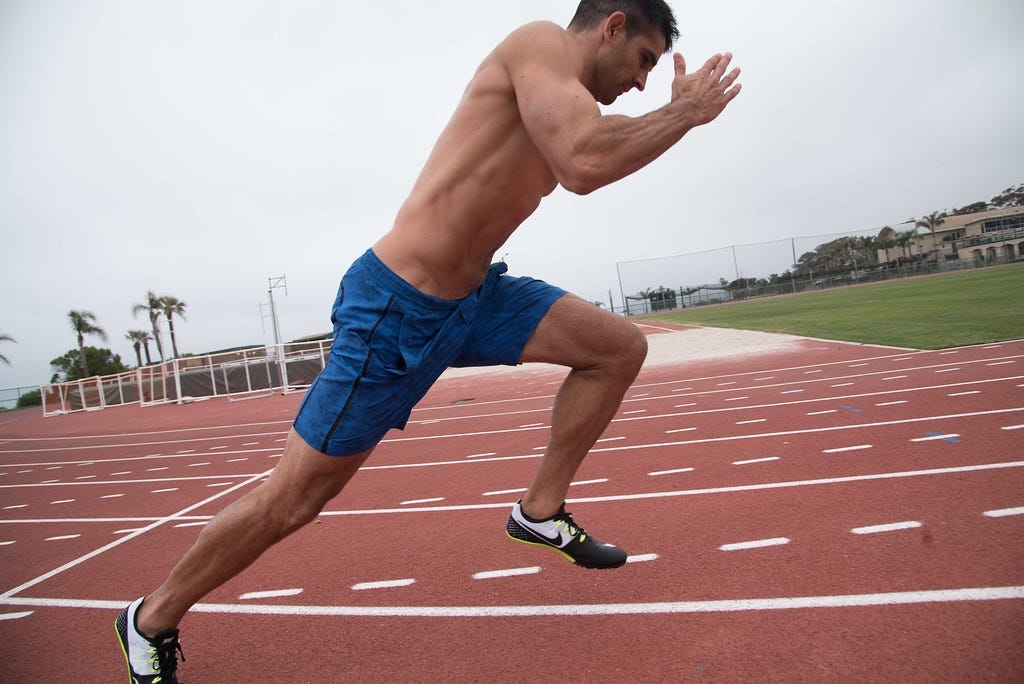
Although in practice we would run the track counter clockwise and clockwise, I have always been right leg dominant - causing my right side rotation to be restricted.
Power Management and Structural Durability
True conditioning is a skill of energy management. High-volume training that relies on sloppy, repetitive fatigue mechanics offers diminishing returns and steep structural costs.
By applying the Minimum Effective Dose framework to multi-planar training, we can construct high-yield, low-volume protocols that build systemic power without draining your battery.
Kettlebells provide an elite mechanism for developing absolute force and violent hip extension. Heavy clubs give us the structural and rotational lens required to direct that force safely in three dimensions. Merging them isn’t about making training more complicated—it’s about making your power usable.
Ultimately, Cross-Modality Conditioning is an adaptable, intelligent framework. Your choice of movements on any given day should depend entirely on your training goals, what’s fresh, what needs work, and what inspires you to step up to the platform. Build the engine, protect the joints, and step out of the single plane.
Deepen Your Practice
To understand the core foundations and evolutionary logic behind this methodology, read the piece where it all started:
Cross Modality Conditioning

Conditioning based on StrongFirst Anti-Glycolytic principles builds the athletic engine. Harnessing the power of the kettlebell + the clubbell, I have begun to practice time-efficient training sessions that cover broad bases for adventurous pursuits.
Conditioning based on StrongFirst Anti-Glycolytic principles builds the athletic engine. Harnessing the power of the kettlebell and the clubbell, I have begun to practice time-efficient training sessions that cover broad bases for adventurous pursuits.
This piece exists because a member asked how to program kettlebell and club conditioning without wrecking recovery.
“I’m definitely moving better even just a few weeks in. You also got me to take conditioning more seriously — trying to do something, not just train, six days a week.”
— Ben, StrengthAxis Elite member
If there’s something specific you want covered, Elite members can request it directly through the check-in form.
Stay Strong,
John Parker
StrengthAxis