


There are coaches who teach exercises.
There are coaches who teach systems.
And then there are coaches who quietly shape the way you think.
Franz Snideman was one of those people for me.
I first met Franz nearly two decades ago after wandering into Revolution Fitness in La Jolla, CA as a young track athlete who had discovered kettlebells but had absolutely no idea what he was doing.
I recognized him from old CHEK Institute videos and introduced myself. Instead of brushing off some random twenty-three-year-old kid, he spent fifteen minutes teaching me how to swing a kettlebell properly.
At the time, that felt significant.
Looking back, it probably shaped the next twenty years of my career.
The Franz I met then is largely the same Franz that exists today: endlessly curious, wildly enthusiastic, and seemingly incapable of separating movement from philosophy.
Our conversation moved through kettlebells, sprinting, StrongFirst, medicine balls, mobility systems, aging and coaching, but the real topic hiding underneath all of it was something else entirely:
Optionality.
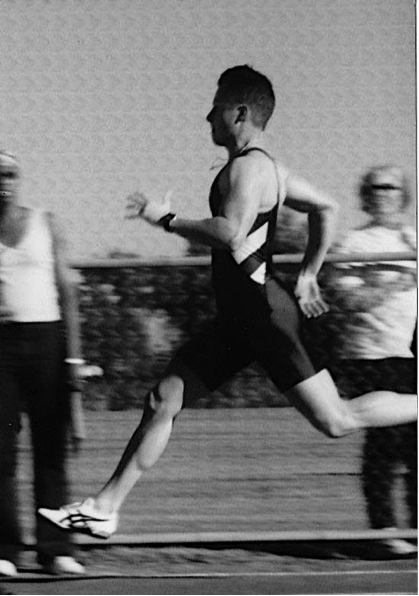
Franz in action 🏃
Franz has his own SubStack that I read fervently. Check it out.
Harambe System
This podcast is proudly sponsored by Harambe System - a variable resistance platform that has fundamentally changed the way I approach strength training, recovery, and long-term sustainability.
Over the past two years, variable resistance training has allowed me to train hard while keeping my joints healthier, improving movement quality, and exploring strength through a much more athletic lens.
The CyberPlate and CyberBar system bridges the gap between bands and weights by creating smoother, more consistent resistance through a full range of motion.
The result: high-quality tension, less joint irritation, greater movement freedom, natural auto-regulation, and performance without constantly feeling beat up.
If your goal is to build real-world strength while staying capable outside the gym, it’s one of the most valuable tools I’ve used.
HarambeSystem.com/JohnParkerBallistic
Franz offered what may be my favorite definition of athleticism in years.
“Athleticism is optionality.”
Not because a deadlift number doesn’t matter, or because strength isn’t important, but because those things are ultimately only pieces of a much larger puzzle.
Can you still sprint?
Can you jump?
Can you rotate, throw, climb, hike, and absorb force?
Can you trust your body in unfamiliar environments and unexpected situations?
Can you move through the world with confidence rather than caution?
Somewhere along the way, the fitness industry became obsessed with specialization. We became powerlifters, runners, bodybuilders, endurance athletes — increasingly competent inside smaller and smaller circles.
Franz’s philosophy has always felt like a quiet rebellion against that trend.
More generalist than specialist.
More adaptable than optimized.
Less interested in maximizing a single quality, and more interested in preserving as many human capacities as possible for as long as possible.


One of my favorite stories from the conversation was one I had almost forgotten entirely.
Before kettlebells, Franz was the Swiss ball guy.
In fact, he was preparing to open an entire studio built around Swiss balls, cable systems, and the functional movement philosophy that had emerged from the early CHEK Institute days.
Then a kettlebell showed up.
Not long after, Franz found himself in Santa Monica taking a private lesson with Pavel Tsatsouline. Swings, snatches, windmills, bent presses — movements that at the time felt almost foreign to the traditional fitness world.
What struck him wasn’t the strength component.
It was the familiarity.
The swing didn’t feel like lifting weights: It felt like sprinting.
The glutes snapping into extension.
The hamstrings loading and releasing like springs.
The brief moment of weightlessness that exists between force production and flight.
For someone with a track background, the pattern was immediately recognizable.
He wasn’t looking at a new exercise —he was looking at another expression of power.
Twenty-four years later, Franz still returns to the same idea:
power changes people.
Not simply because it makes us stronger, but because it preserves something much easier to lose as we age — our ability to move through the world explosively, confidently, and without hesitation.
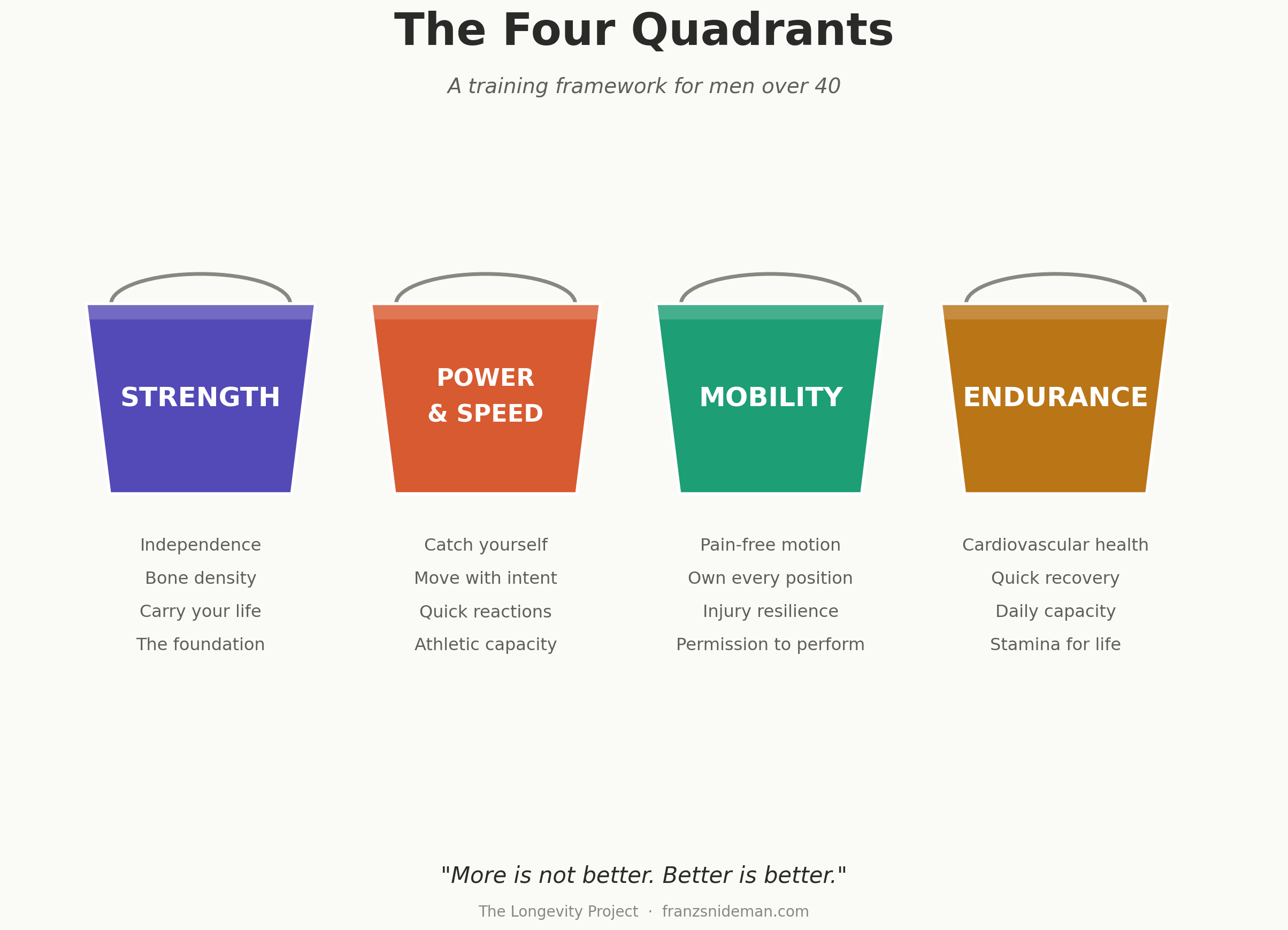
The Dangerous Seventy-Year-Old.
Perhaps my favorite section of the conversation revolved around what Franz called the “dangerous” seventy-year-old.
Not dangerous in the conventional sense —dangerous because they still possess capabilities that most people quietly surrendered decades earlier.
They can still sprint.
They can still jump.
They can still rotate, hike mountains, carry awkward objects, climb over obstacles, and get themselves off the ground without assistance.
Most importantly, they still possess options.
That idea landed hard for me because most people don’t lose their physical lives all at once.
They lose them gradually
The sprint disappears first.
Then the jump.
Then the confidence to move quickly.
The floor becomes inconvenient.
The stairs become something to negotiate rather than climb.
Carrying luggage becomes a chore.
Getting off the ground requires strategy rather than instinct.
Aging rarely arrives as catastrophe: more often, it arrives as subtraction… A quiet narrowing of the world and the number of ways we’re able to move through it.
Franz’s argument wasn’t that everyone needs to become a sprinter.
It was that we should fight much harder to hold onto the capacities that make us feel capable, resilient, and undeniably human.
At fifty-two years old, Franz is still trying to get faster.
He’s still sprinting, still jumping, and still chasing that strange feeling of flight that only seems to exist at top speed — that brief moment when your feet spend more time in the air than on the ground and movement feels almost effortless.
That pursuit struck me as deeply important.
Not because everyone needs to sprint. Most people won’t, and that’s perfectly okay.
But there is something profoundly admirable about refusing to voluntarily surrender parts of yourself simply because the calendar insists you should.
Somewhere along the way we’ve accepted the idea that aging should involve an inevitable narrowing of our capabilities. That there is an appropriate age to stop running, stop jumping, stop exploring the edges of what our bodies can still do.
Franz seems uninterested in that agreement out of respect for the capacities he spent a lifetime building.
And perhaps that’s the real lesson:
Use it, nurture it, challenge it — or eventually lose it.
One of Franz’s best coaching concepts came in the form of three simple dials:
Velocity.
Range of motion.
Planes of motion.
Every exercise can become easier or harder by manipulating one of those variables.
In many ways, great coaching is simply knowing which dial to turn.
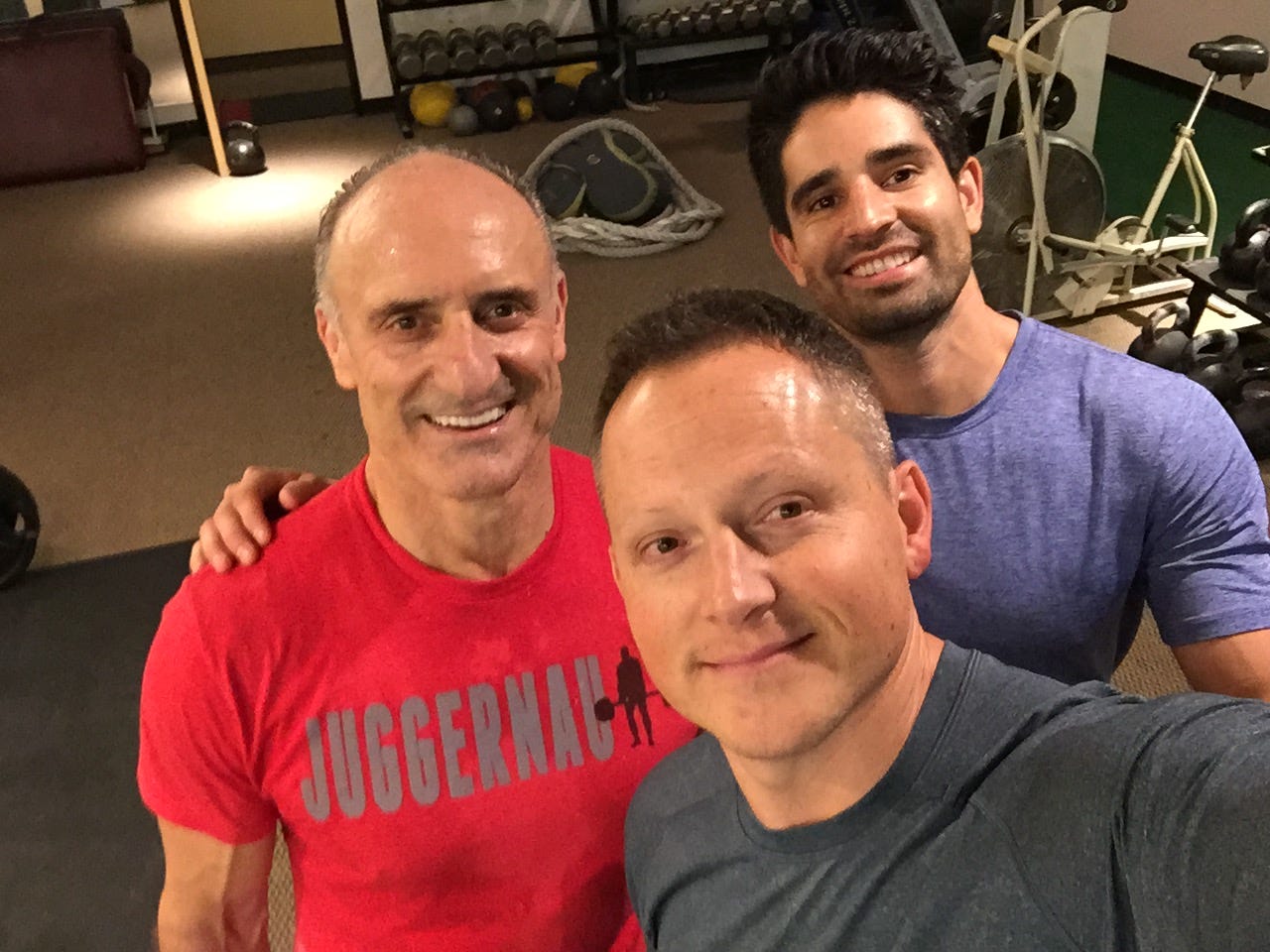
Revolution Fitness - La Jolla, CA ca. 2017. Speaking of “Dangerous Seventy-Year-Olds!” I’m not sure if Bob was quite 70, but he got after it… deadlifts, battle ropes, kettlebell swings. Bob later went on to become an American record holder in multiple disciplines of Ski Erg. Franz trained Bob for many years and it was a sight to see.
The modern fitness industry has a habit of mistaking intensity for effectiveness.
If a session leaves you exhausted, it must have worked.
If you aren’t sore, it wasn’t hard enough.
If the number on the bar isn’t increasing, progress must have stalled.
Franz has always felt somewhat immune to that way of thinking: The goal was never exhaustion for its own sake —> It was to remain capable, to stay powerful.
To preserve curiosity about movement and maintain access to as many physical qualities as possible for as long as possible.
Strength matters.
Muscle matters.
Work ethic matters.
But none of those qualities should come at the expense of the very thing training was supposed to protect in the first place: your ability to move through life with confidence and freedom.
At one point during our conversation, Franz compared the human body to a Ferrari.
If you’re fortunate enough to own one, you should probably drive it once in a while.
Not recklessly. Not to prove anything to anyone else. Just enough to remember what it was built to do.
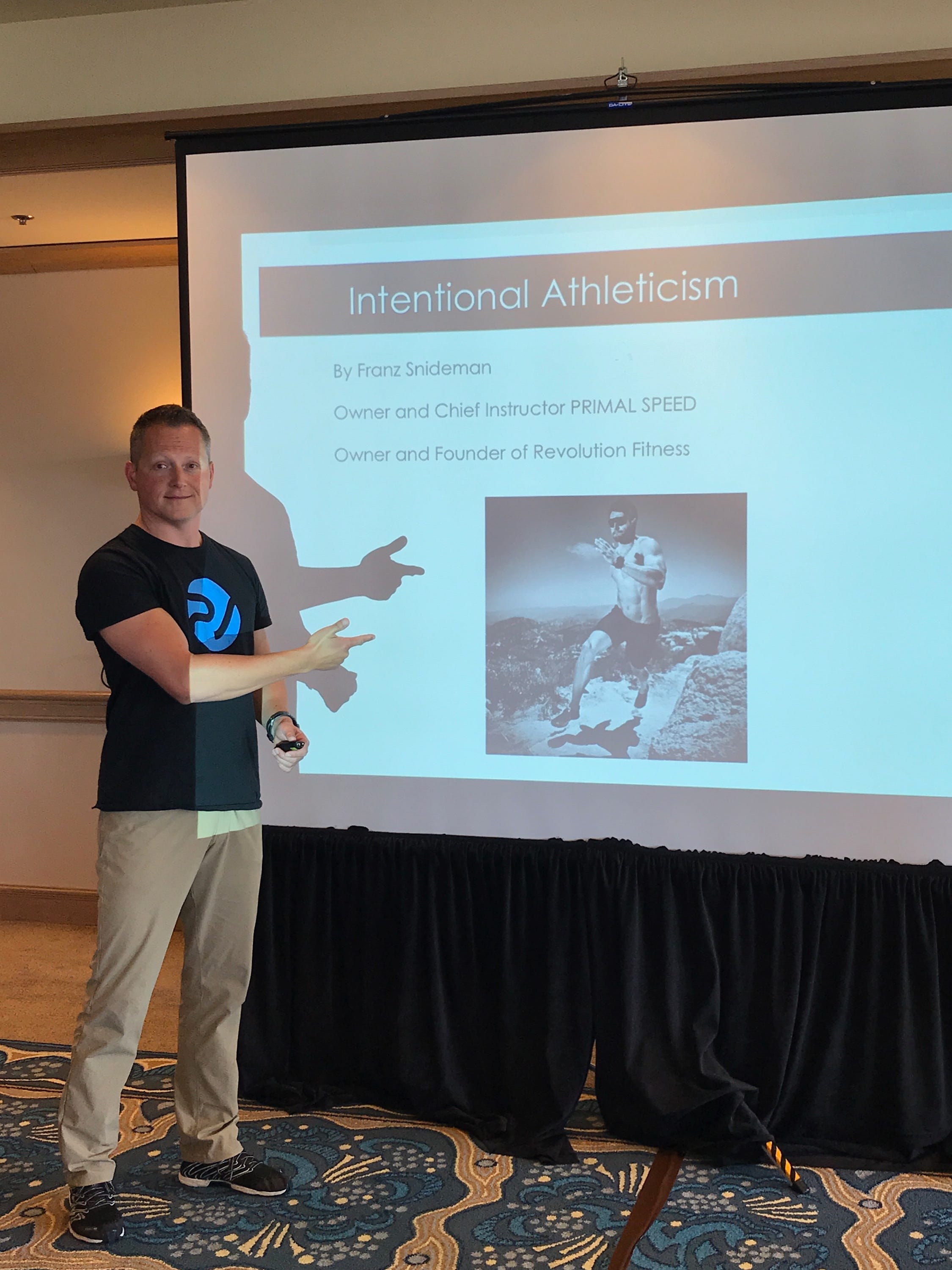
Franz teaching Primal Speed - honored for him to have used my picture!
Books, Concepts & References Mentioned
John Parker
StrengthAxis


